Could Fright Fest Save Six Flags?
By Leonard Pickel, Owner of Hauntrepreneurs Themed Design and Consulting 
In the high-stakes world of theme parks, the fall season—once a quiet shoulder period that maintenance departments used to winterize rides and machinery—has become a billion-dollar juggernaut. Entertainment venues of all sizes are creating Halloween-themed events and attractions. Farms, FECs, Racetracks, Skating Rinks, even carwashes are all scaring people in October. Halloween is huge and getting bigger, with some events opening in early August. As Six Flags navigates a challenging post-merger landscape with executive shakeups and sputtering financials [1], a critical question remains: could a revitalized, high-quality Halloween event be the key to the chain’s revival? It worked for Knott’s Scary Farm.
How Scary Farm Saved Knott’s
Knott’s Berry Farm started as a beloved but seasonally dependent family amusement park—some say it was America’s first-ever “theme park”—but in 1973 it was struggling [2]. Disneyland had moved in down the road and attendance was dropping. Brainstorming for events that could bring additional revenue, the Knott’s creative team experimented with a spooky three-night event in October. “The Halloween Haunt” [3], featuring one themed maze and some roaming monsters, was an instant, sell-out success, creating a powerful new business model that transformed the park’s financial future [4].
 I remember attending Knott’s Scary Farm in the 1980s, and was blown away not only by the number of haunts—six or seven at the time, if I recall correctly—but also by the sheer variety of themes and styles. There was a static “Scary Tales” in one maze and in another, a full-blown vampire opera delivered in song while we walked through what I think was a dry water ride. The creativity and level of detail were amazing for the time. Knott’s Scary Farm became the “Granddaddy of Halloween Events,” pioneering the park-wide, hard-ticketed haunt experience we all know and love today [5]. It single-handedly turned the parks fall season into a peak attendance event, driving massive ticket sales and revenue that helped the park navigate a financially challenging period. In fact it’s widely accepted that Scary Farm alone saved Knott’s.
Eventually, the challenge of installing the next great rollercoaster to drive kids to your park became too much, Knott’s was sold to Cedar Fair in 1997. At the time, I was excited about the merger, thinking it would elevate Cedar Fair’s HalloWeekends event to the level of Knott’s. After all, Scary Farm had a documented library of successful, innovative haunt designs from years Scary Farms Productions. Instead, the HalloWeekends haunts stayed largely the same, and the Scary Farm mazes seemed to lose the effectiveness and originality they were known for. Perhaps due to tighter budgets after the park’s acquisition.
Hope for a Brand in Turmoil
Today, Six Flags is facing its own period of significant uncertainty. A merger with Cedar Fair was followed by a 9% second-quarter attendance drop in 2025 [1]. After the departure of its CEO and executive chairman, the company’s stock also dropped. For park fans, the results have included delayed ride openings, broken coasters, a lack of staff, and a pervasive sense of instability [1, 2]. Amidst all this were the parks annual “Six Flags Fright Fest,” reviews of which frequently position the event as a mid-tier offering, falling well short of other elite Halloween attractions [6, 7].
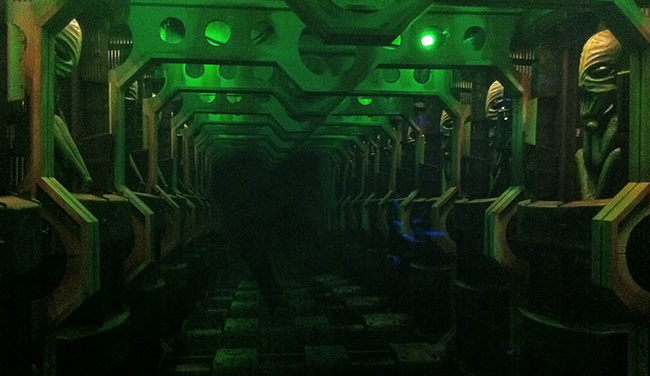
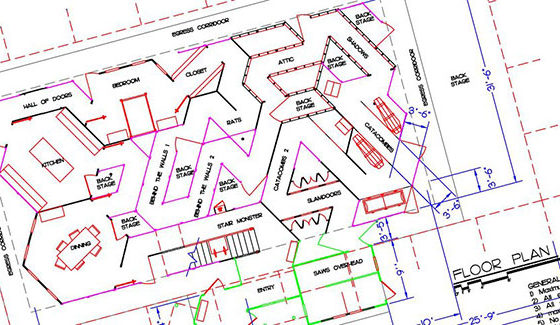
Last October, with most of my clients open and generating revenue, I had the chance to travel and experience some of the country’s best attractions. I hadn’t been to a Fright Fest in several years, but this year’s event was open on Columbus Day night, so I took advantage and checked it out. Most of the 5 or 6 haunts were what I expected: middle-of-the-road concepts, light scenic design with midrange acting, and horrible sightlines, falling far short of even the local independent haunts in that market. They did feature one IP-based haunt, built by an outside design company, which was a step in the right direction. However, the overall experience was marred by low-quality audio and teen employees in sloppy street clothes mumbling rules at us about not punching the actors. Or so I assumed; I couldn’t understand a word. Then I entered one of the walkthroughs and was genuinely amazed. What I experienced was a new style of haunted house that, after my 60-some years of attending hundreds of haunts in a season, I had never seen or even thought of before. It was a mix of existing styles (there are no new ideas, only old ones put together for the first time), but this was true innovation, found in the most unexpected of places. It made me wonder if Fright Fest could save Six Flags, just like Scary Farm saved Knott’s?”
From “Good Enough” to Amazing
Reviews from both enthusiasts and critics regarding this year’s Fright Fest events continue to highlight familiar issues: inconsistent haunt quality [8], lack of cohesive storylines [8], low creativity, understaffing [9, 10], and a confusing ticket structure [11]. This leads to one clear conclusion: Fright Fest has fallen into the trap of being “good enough” to attract its existing season pass base but not “amazing enough” to draw die-hard fans from afar. Fright Fest seems designed as merely a perk for pass holders, rather than a primary reason to buy a pass in the first place—a massively missed opportunity. While Fright Fest is a successful profit center as a seasonal promotion, it is not the marquee, brand-defining destination event it could be.
They Tried This Once Before
The irony is that Six Flags has already attempted a corporate-wide haunted event upgrade before, and its failure holds the key to future success. In a move to standardize and elevate Fright Fest, Six Flags corporate purchased an attraction concept in 2000, from the animatronic prop company Distortions Unlimited called “Brutal Planet” [16]. It was an apocalyptic, world-without-hope themed attraction designed by legendary haunt designer John Burton, featuring an innovative streetscape “crossover scene” engineered to use paying guests as “extras in the film.” The maze path wandered back and forth across the street between building facades, which, when viewed from one end, transformed patrons into zombie-like characters wandering the streets.
The problem with this was twofold. First, the “one-size-fits-all” concept was forced upon all the parks, some of which already had locally loved Halloween-themed attractions, decorations, signage, and characters they had developed. This top-down edict caused resentment among park-level creative teams and park-goers alike who loved their local haunted houses.
Secondly, Brutal Planet had a serious, end-of-the-world theme, that didn’t genuinely fit the family target audience of Six Flags. And while the concept was strong, the corporate office provided little to no on-site support for how to turn a friendly park into the “most horrible thing man can imagine” (as John Burton describes his attractions). No help was provided from the original designers, and each park was expected to implement the complex new direction in-house. Most parks didn’t even have the space to utilize the key crossover design, and the execution was inconsistent and underfunded. The idea wasn’t bad; it was the top-down execution and lack of support that caused the failure. After just a season or two, the Brutal Planet initiative was dropped, leaving the parks directionless and on their own [16].
A Scary Farm-Level Renaissance
Knott’s used Halloween to create a legendarily successful destination event [5]. There is no reason why Six Flags could do the same. The financial power of a world-class Halloween event is no longer an industry secret; it is the proven playbook for success [14, 15]. For parks that commit to a high-quality, destination-worthy event, Fall is no longer a slow shoulder season—it has become an attendance peak, with some operators earning up to 27% of their entire annual income in just a few weeks in October [12]. The per-capita spending of a haunt guest is significantly higher, driven by premium tickets, express passes, branded merchandise, themed food, and adult beverages. Universal’s Halloween Horror Nights is so profitable it is widely referred to as the park’s “thirteenth month” of revenue [13].
While a transformative “Fright Fest” will require significant investment, the merger with Cedar Fair presents unique advantages. Unlike Knott’s 52 years ago, Six Flags now has the example of other parks to follow and can leverage Cedar Fair’s deep library of documented Scary Farm designs. This, coupled with the strategic advantage of rotating innovative new mazes between parks, creates an opportunity to effectively amortize significant up-front costs while ensuring fresh, compelling attractions for each park to promote every season.
The imperative is to commit to creative excellence: establishing a central creative think tank staffed by the world’s leading independent attraction designers. This specialized team would be responsible for conceptualizing and delivering cutting-edge mazes, shows, and scare zones for all Six Flags and Cedar Fair parks. Just as Scary Farm became Knott’s financial lifeblood, a truly world-class “Fright Fest”—driven by innovation and creative leadership—can serve as the ultimate catalyst for Six Flags’ recovery. This strategic leap would elevate Fright Fest from a profitable seasonal offering to a genuine cultural touchstone, profoundly reshaping the company’s trajectory and public perception. It’s an unparalleled opportunity for Six Flags to re-establish itself as an industry leader, known not just for its iconic rollercoasters, but for defining the pinnacle of thrilling, frightful festivities.
Leonard Pickel is a themed attraction designer/consultant and lover of all things scary. Check out his website at www.hauntrepreneurs.com or contact him at leonard@hauntrepreneurs.com
Article Sources
- “Six Flags Attendance Drops 9% in Q2 Amidst Merger Uncertainty,” themeparktribune.com
- “Knott’s Berry Farm,” en.wikipedia.org/wiki/Knott%27s_Berry_Farm
- “Knott’s Scary Farm,” knotts.com/events/scary-farm
- “Knott’s Berry Farm’s Halloween Haunt has been scaring visitors for 50 years,” sfgate.com
- “A brief, bloody history of Knott’s Scary Farm,” latimes.com
- “Fright Fest worth it?” reddit.com/r/sixflags/comments/16l5q8w/fright_fest_worth_it/
- “Six Flags’ Fright Fest Isn’t Worth The Price Of Admission,” themeparkinsider.com
- “Six Flags Fright Fest Review – Las Vegas,” daringdamselslv.com
- “Six Flags Fright Fest 2023 Review – Is It Worth It?” youtube.com/watch?v=example_review_video
- “Six Flags Fright Fest 2023 Review: More Tricks Than Treats,” thathashtagshow.com
- “Is the Six Flags Fright Fest Pass Worth it?” tartanshield.com
- “Theme park Halloween events: a spooktacular investment,” blooloop.com
- “Universal’s Halloween Horror Nights Is A Cash Cow,” forbes.com
- “The Economics of Haunted Attractions,” seasonalentertainmentsource.com
- “A Study on Economic Impact of Themed Events in Amusement Parks,” ijaem.net
- “A Look Back at Brutal Planet,” hauntrater.com/brutal-planet-retrospective


